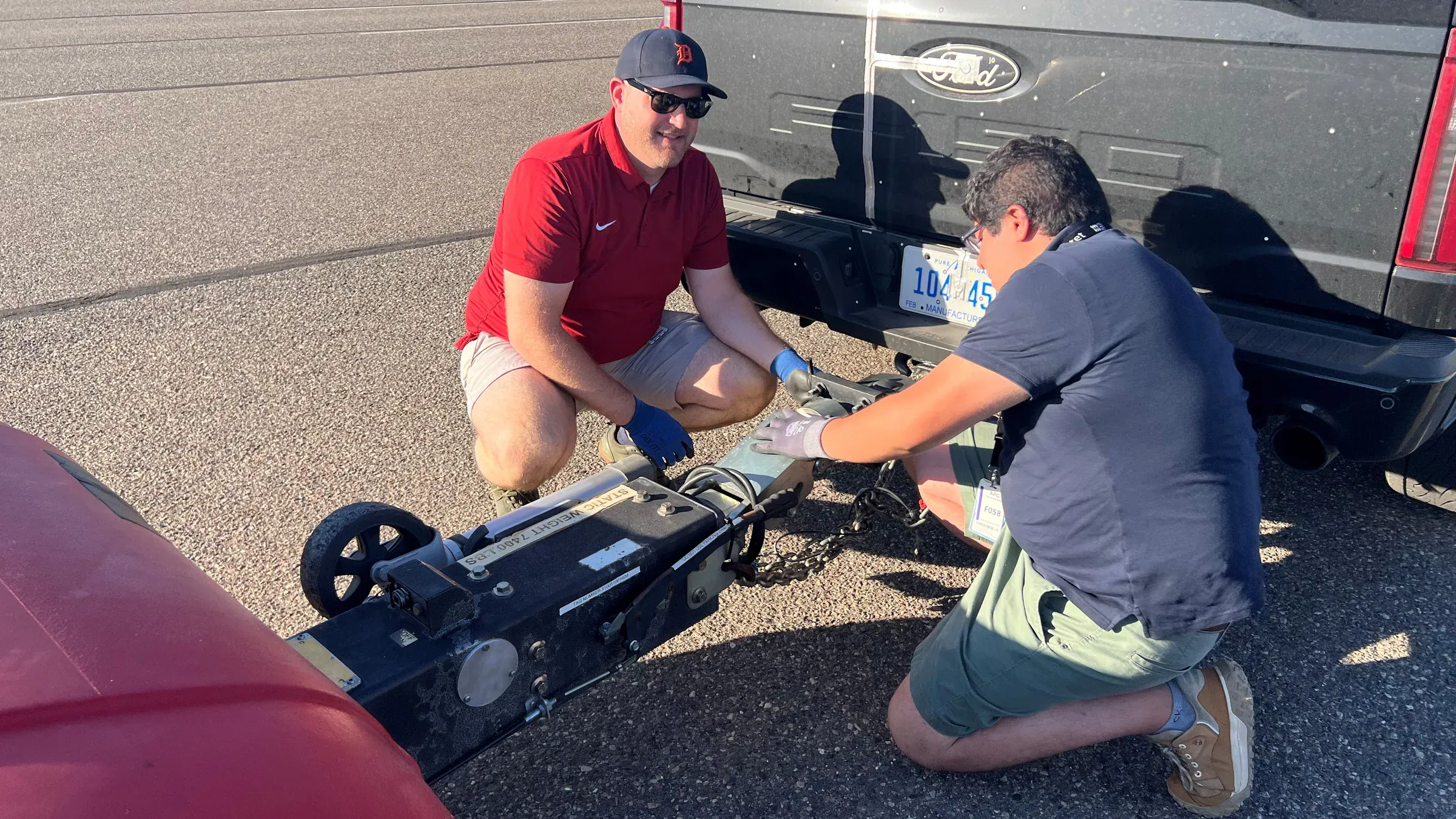
The temperature is already 107 degrees at 8:30 in the morning. For Ford's thermal engineers, that is when useful testing begins.
THE DAY STARTS AT 107 DEGREES AND GETS HOTTER.
Ford thermal systems engineer Stephen Kluck says summer temperatures at the Arizona Proving Ground regularly climb north of 110 degrees. That environment gives the engineering team something a laboratory cannot fully replace: sustained desert heat acting on an entire vehicle while it is being driven and placed under load.

TOWING TURNS HEAT INTO A SYSTEM WIDE TEST.
A trailer asks the engine, transmission and cooling system to work harder at the same moment hot outside air makes it more difficult to reject heat. Ford uses a tow dynamometer to apply load at the proving ground, allowing engineers to run a test, review the data, make an adjustment and repeat the evaluation without traveling to a distant mountain grade.

HUNDREDS OF SENSOR READINGS SHOW WHAT THE DRIVER CANNOT SEE.
Ford says the test vehicles monitor hundreds of readings across the powertrain, fuel system, exhaust system and other components. Engineers follow temperatures, pressures and system performance to identify where a vehicle meets its targets and where more development work is needed.
EVEN THE FUEL TEMPERATURE IS CONTROLLED.
Repeatability matters as much as raw heat. Ford preconditions vehicles so separate runs begin from a consistent baseline. For some evaluations, the team also controls fuel tank and bulk fuel temperature. Holding those starting conditions steady makes it easier to understand what changed and whether an adjustment actually improved the result.
THIS WORK MATTERS FAR BEYOND THE DESERT.
A Florida owner may never tow through the Arizona desert, but heat, humidity, traffic and a loaded trailer can still stack demands on a vehicle. The proving ground creates an intentionally severe and repeatable environment. The purpose is not to promise that every vehicle can ignore every condition. It is to discover weaknesses during development rather than after a customer has connected a trailer and started a summer road trip.
This independent report is based on Ford's account of testing at its Arizona Proving Ground. Motor Current did not observe the program and has not independently reproduced the conditions. The photographs are official Ford media images used for editorial reporting. Motor Current received no payment or other compensation.
← RETURN TO MOTOR CURRENT